
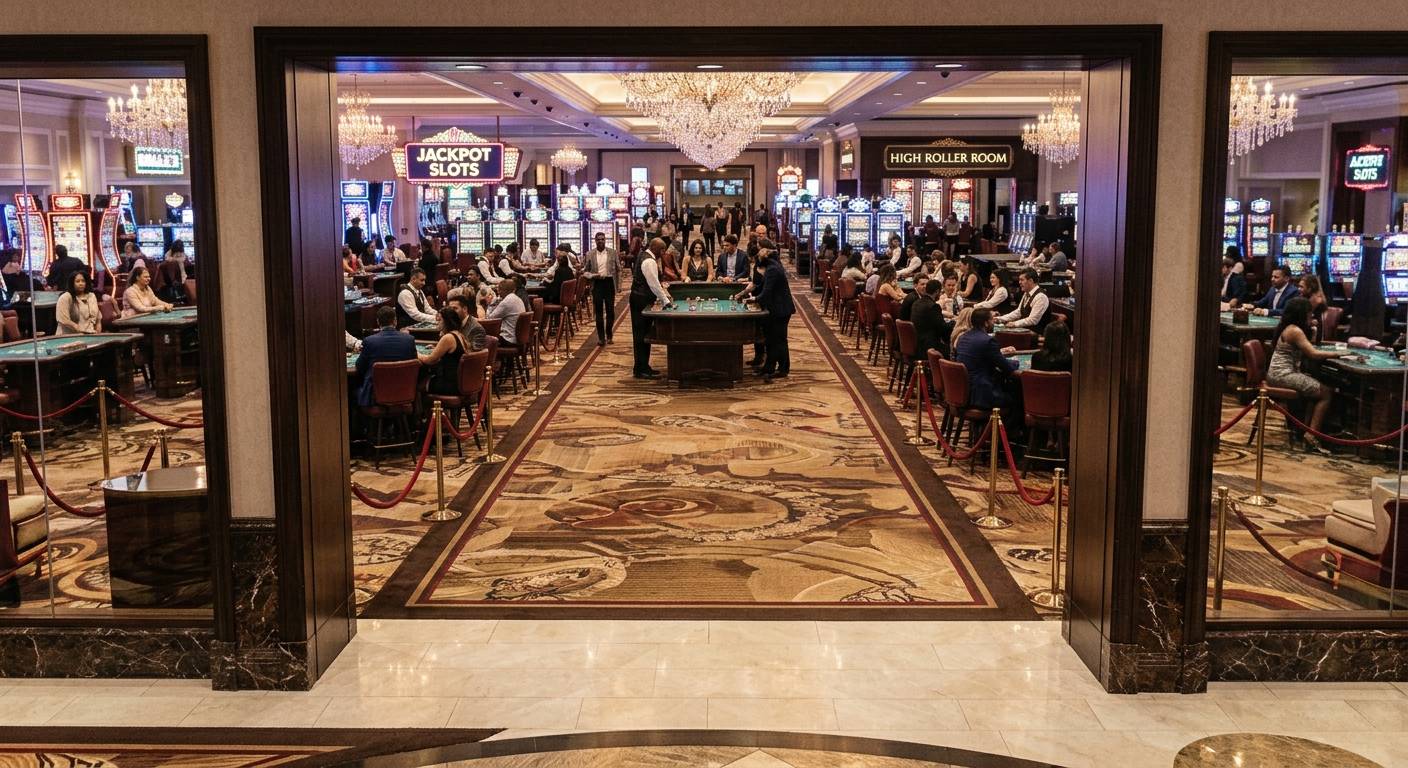
When people picture casino security, they picture a wall of monitors and a surveillance operator staring at a hundred camera feeds, trying to spot the one frame that matters. It’s a familiar image, reinforced by Hollywood. But the real challenge in modern casino operations isn’t catching the dramatic heist. It’s keeping thousands of moving parts running smoothly—cash exchanges, guest flow, employee access, vendor movement—while staying compliant with some of the most tightly regulated security standards in any industry.
And here’s the uncomfortable truth: the more security technology you layer on, the harder it becomes to keep the operation fluid. Casinos are high-traffic environments where every second of delay at an access point or a slow response to an incident has a cascading effect on guest experience and the bottom line.
That’s why a growing number of casinos are turning to AI-powered, walk-through weapon detection—technology that keeps weapons out without making guests feel like they’re entering an airport.
The Real Bottleneck Isn’t the Threat. It’s the Throughput.
Think about your casino’s main entrance, your cashier cage, your employee access points, your high-limit areas. Each one is a security checkpoint. Each one is also a flow point. The two priorities pull in opposite directions.
Traditional security screening—manual ID checks, bag inspections, handheld metal detectors, walk-through metal detectors—creates a trade-off that security directors know all too well. Tighten the inspection, and you create lines. Loosen it, and you invite risk. Add more cameras and analytics, and you increase the data volume that someone has to monitor and act on. Add more alerts, and you risk alarm fatigue.
This is the operational paradox of casino security. More security doesn’t automatically mean more protection—not if the system creates bottlenecks that get bypassed under pressure.
How Walk-Through Weapon Detection Breaks the Trade-Off
Smart CT Solutions is responding with technology that moves the checkpoint away from the “chokepoint” and removes the “chokehold” entirely. Our detection system is designed to be invisible. Guests don’t stop. They don’t empty their pockets. They don’t get wanded. They simply walk in at normal pace while the system screens them in the background.
Our core hardware is two discreet pillars positioned roughly eight feet apart, housing 3D cameras and NVIDIA edge processors running AI models. No guard needs to be at the entrance. If a threat is detected, an alert, along with the person’s image and the weapon’s location on their body is sent to the security team in under 10 seconds.
The operational impact is dramatic:
The numbers tell the story. Real-world airport checkpoint can processes approximately 200 to 300 people/hour per lane. Smart CT Solutions can handle up to 7,200. For a casino with multiple entrances and thousands of daily visitors, that difference isn’t incremental. It’s transformative.