
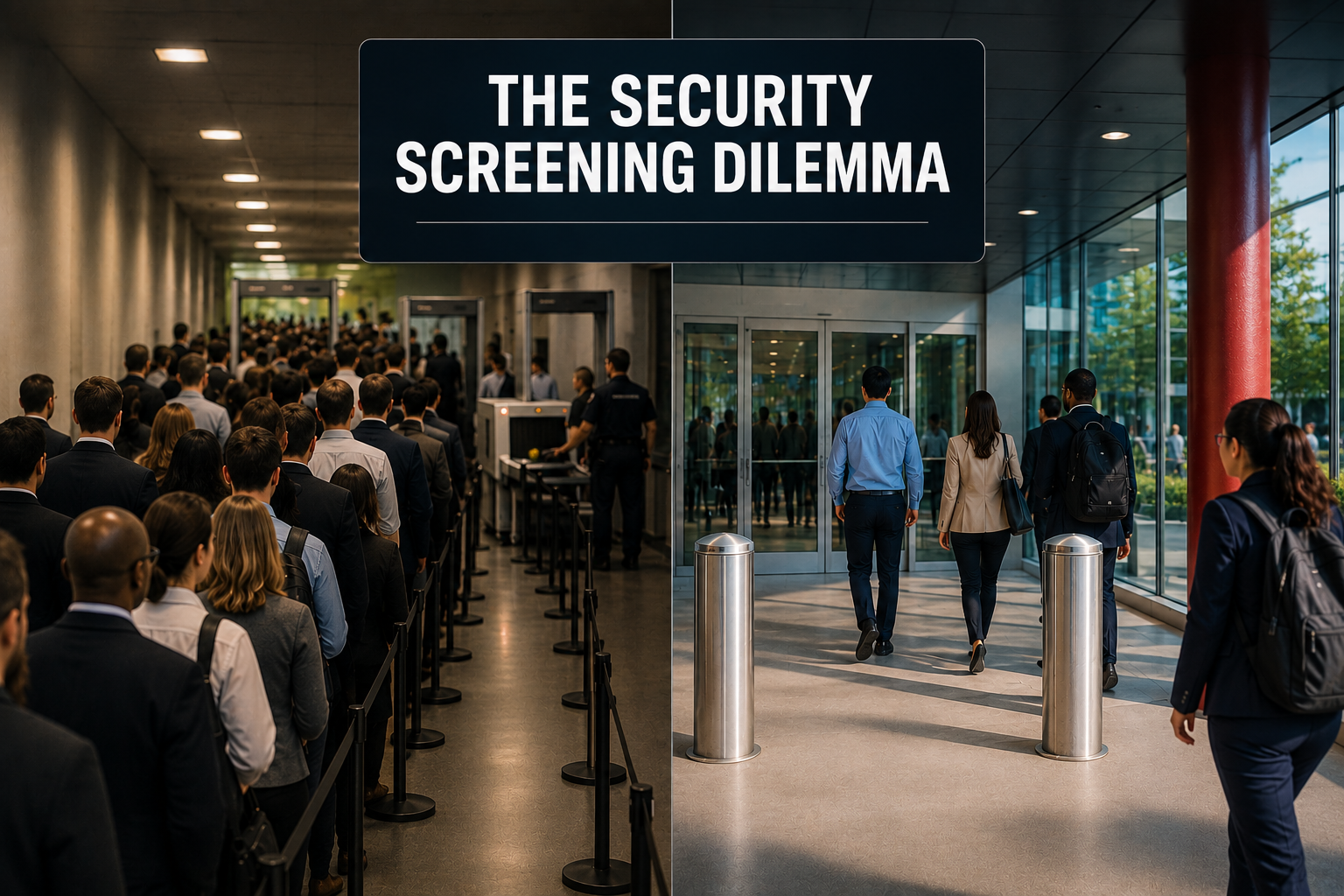
For security directors, protecting a facility entrance often involves a difficult balance. You need to identify potential threats before they enter the building. At the same time, you need to keep people moving.
That balance becomes increasingly difficult as facilities grow busier. Hospitals, universities, corporate campuses, government buildings, transportation hubs, casinos, and other large facilities may have thousands of people entering and exiting every day.
The question is no longer simply: How do we screen people for threats?
A more important question is: How do we maintain effective security without creating an operational problem of our own?
Traditional security screening methods can be effective. However, they often require people to stop, wait, remove personal items, or interact directly with security personnel.
The Traditional Security Trade-Off
At lower traffic volumes, this may be manageable.
At busy entrances, however, screening can create:
- Long lines
- Delays
- Congestion
- Frustrated visitors and employees
- Additional demands on security personnel
This creates a difficult trade-off. The more time-consuming the screening process becomes, the greater its potential impact on traffic flow and the visitor experience.
The faster people need to move through an entrance, the more difficult it may become to maintain the same level of screening. For security directors, this is not simply an operational inconvenience. It is a risk-management issue.
Security Procedures Must Work Under Pressure
A security process may be effective in theory, but its real-world effectiveness depends on whether it can be consistently maintained. Consider a facility where a security checkpoint regularly creates a significant line during peak hours. How would you answe these questions?
- What happens when an event begins?
- What happens when employees are late for work?
- What happens when thousands of visitors arrive at the same time?
- What happens when people urgently need to enter or leave the facility?
Under operational pressure, security procedures may be modified, shortened, or temporarily suspended. This creates one of the fundamental challenges of security planning:
A security system must work not only under ideal conditions, but also under real-world pressure.A process that works well during a quiet period may become difficult to maintain when traffic volume increases.
More Security Does Not Always Mean More Protection
It is easy to assume that adding more security procedures automatically improves security. In practice, the relationship is more complicated. A new checkpoint may improve screening but create longer lines.
Additional manual inspections may improve detection but require more personnel. More security alerts may provide more information but also increase the possibility of alert fatigue. Security directors must therefore evaluate the entire operating environment.
The question is not simply: “Can this security measure detect a threat?”
It is also: “Can we maintain this process consistently, even when the facility is busy?”
The Importance of Security Throughput
Security professionals often use the term throughput to describe how many people or vehicles can move through a process within a specific period of time. For an entrance, throughput is an important operational consideration.
A system that can effectively screen ten people per minute may be perfectly suitable for one facility but inadequate for another. The same is true for a security process that works well during normal operations but cannot handle peak traffic.
This is why security planning should consider:
- Normal traffic volume
- Peak traffic volume
- Special events
- Staffing availability
- Emergency conditions
- Expected response times
A security system should be evaluated against the conditions in which it will actually be used.
Rethinking the Entrance
For many years, security has been associated with visible checkpoints, guards, barriers, and screening stations. These tools continue to have an important role in many environments.
However, security technology is also evolving toward systems that can operate more continuously and with less disruption to normal activity. This creates a different approach to the security checkpoint.
Instead of asking people to stop for every security process, organizations can begin to consider how technology might help identify potential threats while people continue moving through an environment.
The goal is not to eliminate security. The goal is to make security more compatible with the way a facility actually operates.
The Security Director’s Challenge
Every facility has different risks, traffic patterns, building designs, staffing levels, and operational requirements. There is no single solution that works for every environment.
However, the basic challenge is shared by many security directors: How do you maintain effective protection without creating conditions that make the security process difficult to sustain?
The answer may involve a combination of security personnel, procedures, technology, and facility design. What is becoming increasingly clear is that security should be evaluated as part of the entire operation—not as a separate process added to the entrance.
The most effective security measure is not necessarily the one that creates the most visible activity. It may be the one that provides meaningful protection while allowing the facility to continue operating normally.
In our next blog, we will look at how emerging technologies, including artificial intelligence and advanced threat detection, are changing the way security leaders think about the traditional checkpoint.